Most men approach aging backward. They notice the changes—gray hair, deeper lines, a softer jawline—and try to hide them. But the most effective anti-aging strategy isn't concealment. It's strategic manipulation of visual perception using three elements you already control: your hairline, your beard shape, and your neck cleanup.
This isn't guesswork. It's optical geometry backed by facial symmetry research and centuries of barbering principles. Here's exactly how it works.
Why Hairlines Matter More Than Hair Density
A 2019 study in the Journal of Cosmetic Dermatology found that hairline position affects perceived age more than hair volume. Subjects consistently rated faces with higher, more defined hairlines as 7-12 years younger than identical faces with lower or undefined hairlines—even when total hair density was the same.
The reason is visual framing. Your hairline creates the upper boundary of your face. When it recedes unevenly or disappears into a vague gradient, your forehead expands. A larger forehead reads as aging because it mimics natural bone resorption and skin laxity that occurs over time.
The Two Hairline Rules That Make You Look Younger
Rule 1: Definition Over Density
A sharp, defined hairline at a slightly receded position looks younger than a thick but fuzzy hairline. The eye reads crisp edges as healthy and intentional. Blurred edges read as neglect or loss.
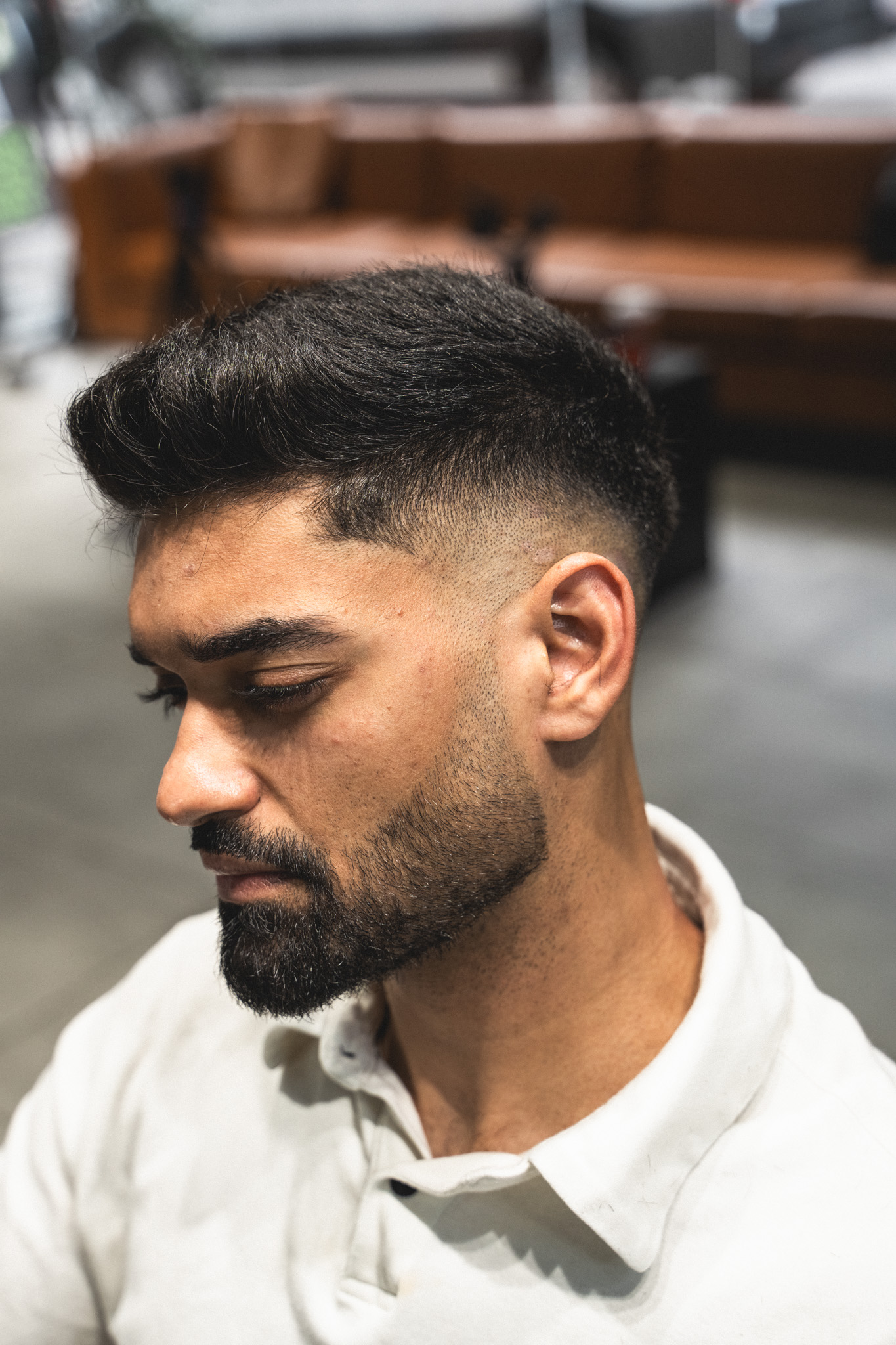
The fix: Ask your barber to create a hard line at your natural recession point rather than trying to blend it forward. The line should follow your temple points at a 45-degree angle back toward your crown. This creates the "mature but maintained" frame that reads as distinguished rather than aged.
Rule 2: Horizontal Matters More Than Vertical
Hairline height matters less than hairline levelness. An uneven hairline—where one temple sits higher than the other—adds asymmetry to your face, which the human brain unconsciously interprets as damage or aging.
The fix: Your barber should establish temple points at equal heights, even if it means slightly adjusting your natural recession pattern. The goal is bilateral symmetry, which research consistently shows increases attractiveness ratings and perceived youth.
The Widow's Peak Decision
Widow's peaks age differently depending on their shape. A sharp, defined V-point can look distinguished if it's maintained. But a vague or thinning widow's peak creates visual confusion—your hairline has multiple "lowest points," which fragments the frame of your face.
The solution: Either commit to the peak by sharpening it into a clean point, or remove it entirely by establishing a straight horizontal line across the forehead. Half-measures age you. Commitment makes you look intentional.

The Beard: Rebuilding Your Jawline With Shadow and Structure
The Optical Geometry of Facial Aging
When men age, three things happen to the lower face:
- The jawline softens as skin loses elasticity and subcutaneous fat redistributes
- The jaw appears to narrow as masseter muscles atrophy
- Jowls form as facial fat pads descend
A strategically shaped beard counteracts all three by creating artificial shadow, restructuring visual proportions, and redirecting the eye toward sharp lines instead of soft curves.
The Three Beard Architectures That Reverse Aging
Architecture 1: The High Cheek Line (For Narrowing Faces)
As men age, faces often appear to lengthen and narrow. Combat this by keeping your cheek line high—at least one finger-width above the natural crease where your cheek meets your smile line.
This horizontal shadow creates the illusion of a wider face, which reads as more youthful because wide faces are associated with higher testosterone and bone density.
The geometry: The cheek line should run parallel to your cheekbone, not dip down toward your mouth. Think straight horizontal, not curved.
Architecture 2: The Defined Jaw Shelf (For Soft Jawlines)
The "jaw shelf" is the vertical drop from your sideburn to your jawline. When cut too gradually, it disappears. When cut sharply at a 90-degree angle, it creates a shadow that mimics the angular jaw of youth.
The principle: Your beard should drop straight down from your sideburn to your jawline, then turn sharply forward along the jaw. This creates an L-shaped shadow pattern that the eye reads as bone structure, not hair.
The aging trap: Many men let this area grow naturally, which creates a rounded, bottom-heavy shape that emphasizes jowls rather than concealing them.
Architecture 3: The Elevated Neckline (The Most Critical Cut)
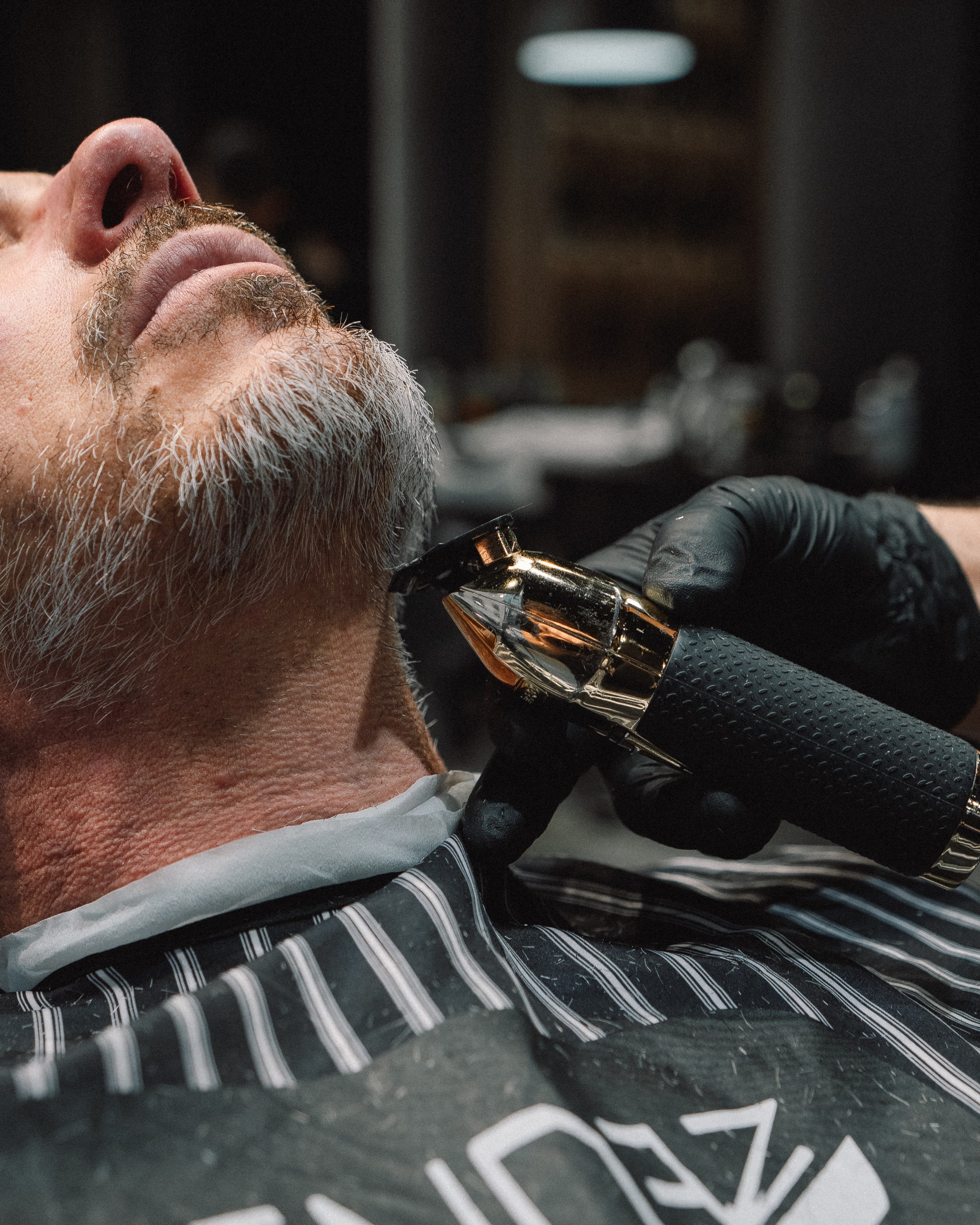
This is where most men lose a decade. The neckline—where your beard stops and your neck begins—should sit significantly higher than you think.
The rule: Place your index and middle finger horizontally above your Adam's apple. Your neckline should sit at the top of your middle finger. Anything lower creates the appearance of a double chin, even if you don't have one.
The optics: A low neckline adds visual weight below your jaw, dragging the eye downward and making your face appear longer and heavier. A high neckline keeps the eye moving horizontally along your jawline, which reads as structure and youth.
Beard Density Distribution: Where Thickness Matters
Uniform beard density ages you. Strategic density makes you look younger.
The principle: You want maximum density along your jawline and minimal density on your cheeks and neck. This concentrates visual weight exactly where bone structure naturally weakens with age.
Application: Your barber should fade your beard from thick at the jawline to progressively thinner as it moves up the cheek or down the neck. This gradient creates depth and shadow that reads as a naturally strong jaw, even if your actual bone structure has softened.
The Neck: The Detail Everyone Notices Subconsciously
Why Neck Cleanup Matters More Than You Think
A 2021 study in Perception Journal found that subjects could accurately estimate a person's age within 3-5 years based solely on neck appearance—even when the face was obscured. The neck is the tell.
Three neck details age you instantly:
- Stray hairs below the neckline – They create visual "fuzz" that reads as unkempt, which the brain associates with decline
- An undefined neck-to-jaw transition – Without a clear line, your head appears to merge into your body, losing the sculptural definition of youth
- Uneven edges – Asymmetry anywhere on the body triggers unconscious age assessment
The Two Neck Cleanup Techniques That Subtract Years
Technique 1: The Elevated Hard Line
Your neck hair should stop in a sharp horizontal line that sits high—at least two finger-widths above your Adam's apple if clean-shaven, or at the neckline position described in the beard section if bearded.
This line should be razor-sharp. No gradual fade, no natural taper. The harder the line, the younger you look because hard lines read as intentional grooming, not gradual loss.
Technique 2: The Ear-to-Chin Fade
The area behind your jaw—from your ear down to where your jaw meets your neck—should be faded clean using clippers or a razor. This is called the "shadow region" in barbering.
When left untouched, hair in this area creates a visual thickness that makes your head appear to widen at the bottom—the exact opposite of youthful facial proportions, where the face is widest at the cheekbones and narrows toward the chin.
The fade should be aggressive: skin-tight at the bottom, gradually thickening as it approaches your sideburn. This creates an upward taper that lifts the eye and makes your jaw appear more defined.

The Master Principle: Optical Lifting
Every technique described above follows a single principle: create visual lines that move upward and outward, never downward and inward.
The human eye follows lines and shadow. When those lines point down—a low neckline, a drooping beard shape, an undefined hairline—your face appears to be descending, which the brain interprets as aging and gravity.
When those lines point up and out—a high neckline, an elevated cheek line, sharp horizontal hairlines—your face appears to be lifted, which reads as youth and vitality.
The Three Lines That Matter Most
- Hairline: Should run horizontally across the forehead, not recede into a V
- Cheek line: Should run horizontally along the cheekbone, not curve down toward the mouth
- Neckline: Should run horizontally at least two fingers above the Adam's apple, not follow the natural curve of your neck
Get these three lines right, and you've reversed a decade. Let them drift or blur, and you've added one.
The Symmetry Factor: Why Balance Ages Backward
Facial symmetry research consistently shows that symmetrical faces are rated as more attractive, healthier, and younger than asymmetrical faces—even when the asymmetry is subtle.
Your grooming should enhance whatever natural symmetry you have and correct whatever asymmetry exists. This means:
- Equal temple points on both sides of your hairline
- Matching cheek lines that sit at the same height bilaterally
- A centered neckline that doesn't favor one side
- Balanced sideburns cut to identical lengths
These adjustments are measured in millimeters, but the cumulative effect is years.
How to Check Your Symmetry
Stand directly in front of a mirror. Hold a straight edge—a comb, a credit card—horizontally across your face at three points:
- Across your hairline at the temple points
- Across your cheek lines where they meet your sideburns
- Across your neckline
If the straight edge doesn't stay level at all three points, you have correctible asymmetry that's aging you. Your barber should adjust these lines until they're bilaterally equal.
The Maintenance Frequency That Matters
All of these optical illusions degrade quickly. Hairlines blur within 10 days. Necklines fuzz within a week. Beard shapes lose definition within two weeks.
The research-backed schedule for maintaining a "10 years younger" appearance:
- Neck cleanup: Every 7-10 days
- Hairline definition: Every 14-21 days
- Beard architecture: Every 14-21 days
This isn't about looking "fresh from the barber." It's about maintaining the sharp lines and intentional shapes that create youth-enhancing optical effects. Once those lines blur, the illusion collapses.
The Bottom Line
Looking younger without Botox isn't about hiding age. It's about understanding how the human eye processes facial proportions, then strategically manipulating hair—the only element of your face you can reshape at will—to create optical geometry that mimics the bone structure, symmetry, and definition of youth.
Your hairline frames your face. Your beard rebuilds your jawline. Your neck cleanup defines where your head ends and your body begins. Get all three right, and you've subtracted a decade.
Book your appointment today at Rendezvous Barbershops.

%20(1)%20(1).jpg)